
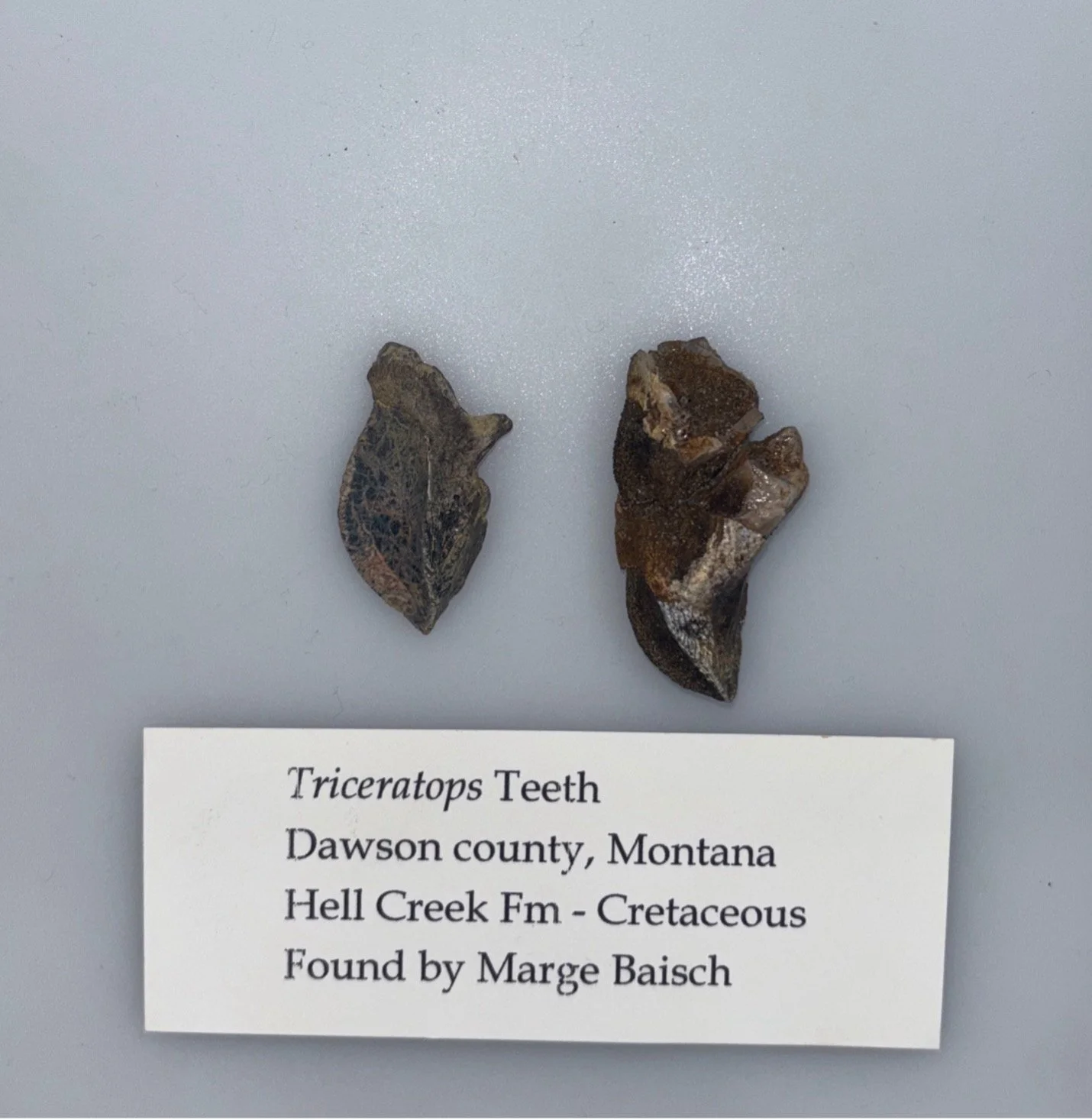
The Triceratops was a tank-sized herbivore that lived up to the end of the age of the dinosaurs. The Triceratops had several defining features like its three horns used to defend against T. Rex attacks and a beak it used to shear palm fronds to eat. The purpose of its large fan-like structure on the back of its head called the ‘frill’ is still a matter of debate. Some think the frill was a defensive measure to protect its neck from the devastating bite of a T.Rex, others think it likely displayed distinctive colors/patterns to attract mates or be recognizable to other Triceratops. There are even theories that it was used as thermoregulation, at the frill was full of veins that could have allowed the animal’s blood to cool.
At Earth Experience, we have been lucky enough to be able to work on a Triceratops skull from the Hell Creek Formation in Montana. Our specimen is likely a subadult, meaning that even with its size, full grown Triceratops would still be slightly bigger. Due to erosion, our skull is missing its horns, which is unfortunately common with Triceratops fossils. It does still have a lot of its frill still protected in its plaster jacket until more of the base skull is prepared and stabilized. Come see this work in progress in person!
The Triceratops was a tank-sized herbivore that lived up to the end of the age of the dinosaurs. The Triceratops had several defining features like its three horns used to defend against T. Rex attacks and a beak it used to shear palm fronds to eat. The purpose of its large fan-like structure on the back of its head called the ‘frill’ is still a matter of debate. Some think the frill was a defensive measure to protect its neck from the devastating bite of a T.Rex, others think it likely displayed distinctive colors/patterns to attract mates or be recognizable to other Triceratops. There are even theories that it was used as thermoregulation, at the frill was full of veins that could have allowed the animal’s blood to cool.
At Earth Experience, we have been lucky enough to be able to work on a Triceratops skull from the Hell Creek Formation in Montana. Our specimen is likely a subadult, meaning that even with its size, full grown Triceratops would still be slightly bigger. Due to erosion, our skull is missing its horns, which is unfortunately common with Triceratops fossils. It does still have a lot of its frill still protected in its plaster jacket until more of the base skull is prepared and stabilized. Come see this work in progress in person!