
FossilsExplore our collection of fossils by time period
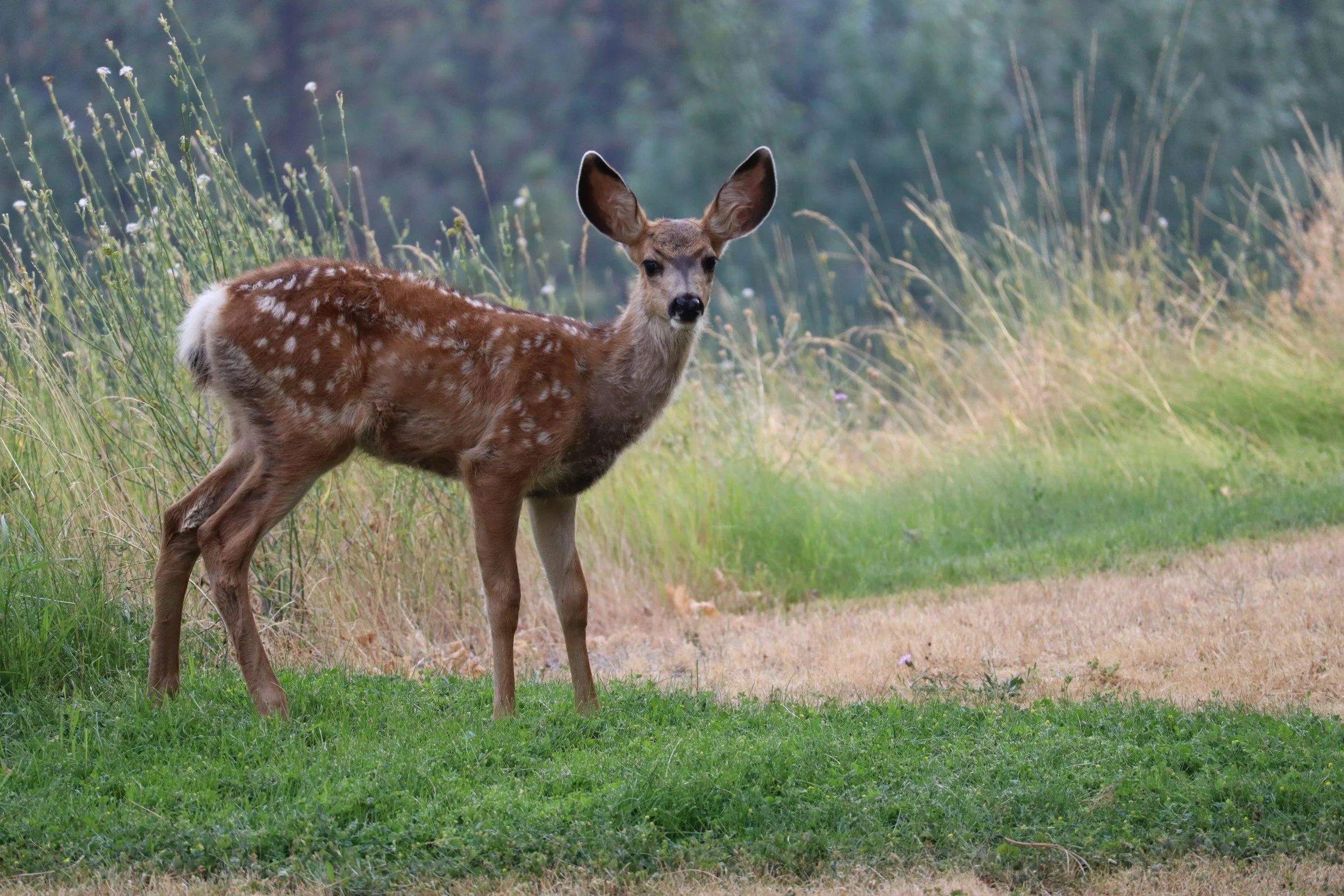
Holocene (11,700 years ago to the present)
We are currently living in the Holocene epoch. In this section, you'll find fossils of familiar animals, many of which are still living on Earth today.

Mauricio Antón, CC BY 2.5 <https://creativecommons.org/licenses/by/2.5>, via Wikimedia Commons (cropped)
Pleistocene (2.58 million to 11,700 years ago)
The Pleistocene epoch was relatively recent in Earth’s history. Much of the natural world looked familiar to the one we know today, and many modern animals existed in some form or fashion during this time. However, the Pleistocene is associated with large, sometimes strange looking animals called megafauna. Among these are the giant ground sloth, wooly mammoth, and dire wolf. Other noteworthy animals from this time are saber tooth cats and even several species of early humans like Homo neanderthalensis (Neanderthals) and Homo sapiens (modern humans).
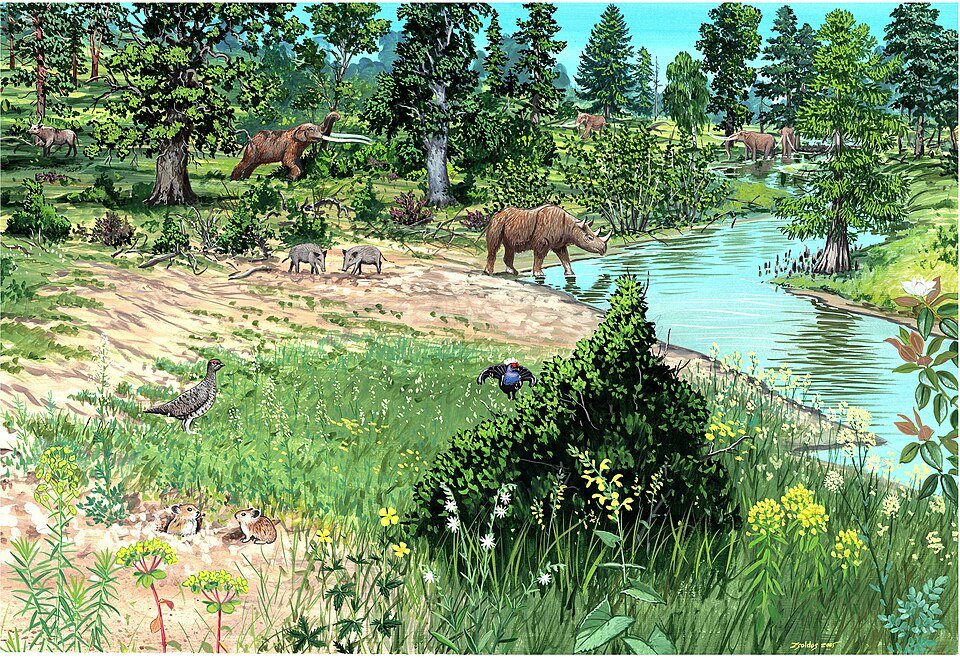
Márton Zsoldos, CC BY 4.0 <https://creativecommons.org/licenses/by/4.0>, via Wikimedia Commons
Pliocene (5.33 to 2.58 million years ago)
The Pliocene epoch acted as a transition from the warm climate of the Miocene to the colder temperatures of the Pleistocene. During this time, grasslands and herding animals began to flourish. This time period also saw the development of early human ancestors like Australopithecus.
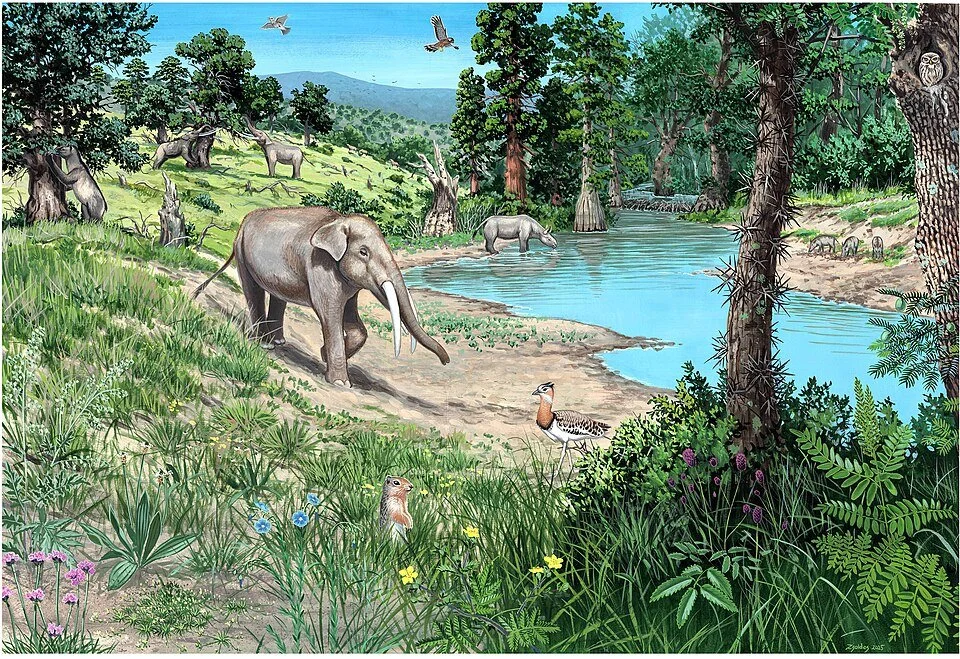
Márton Zsoldos, CC BY 4.0 <https://creativecommons.org/licenses/by/4.0>, via Wikimedia Commons
Miocene (23 million to 5.3 million years ago)
The Miocene was a time of geologic and climate change. Dense forest environments shrank while grasslands spread, the climate became cooler and drier, and tectonic movement caused the formation of new mountain ranges like the Himalayas and Andes ranges.
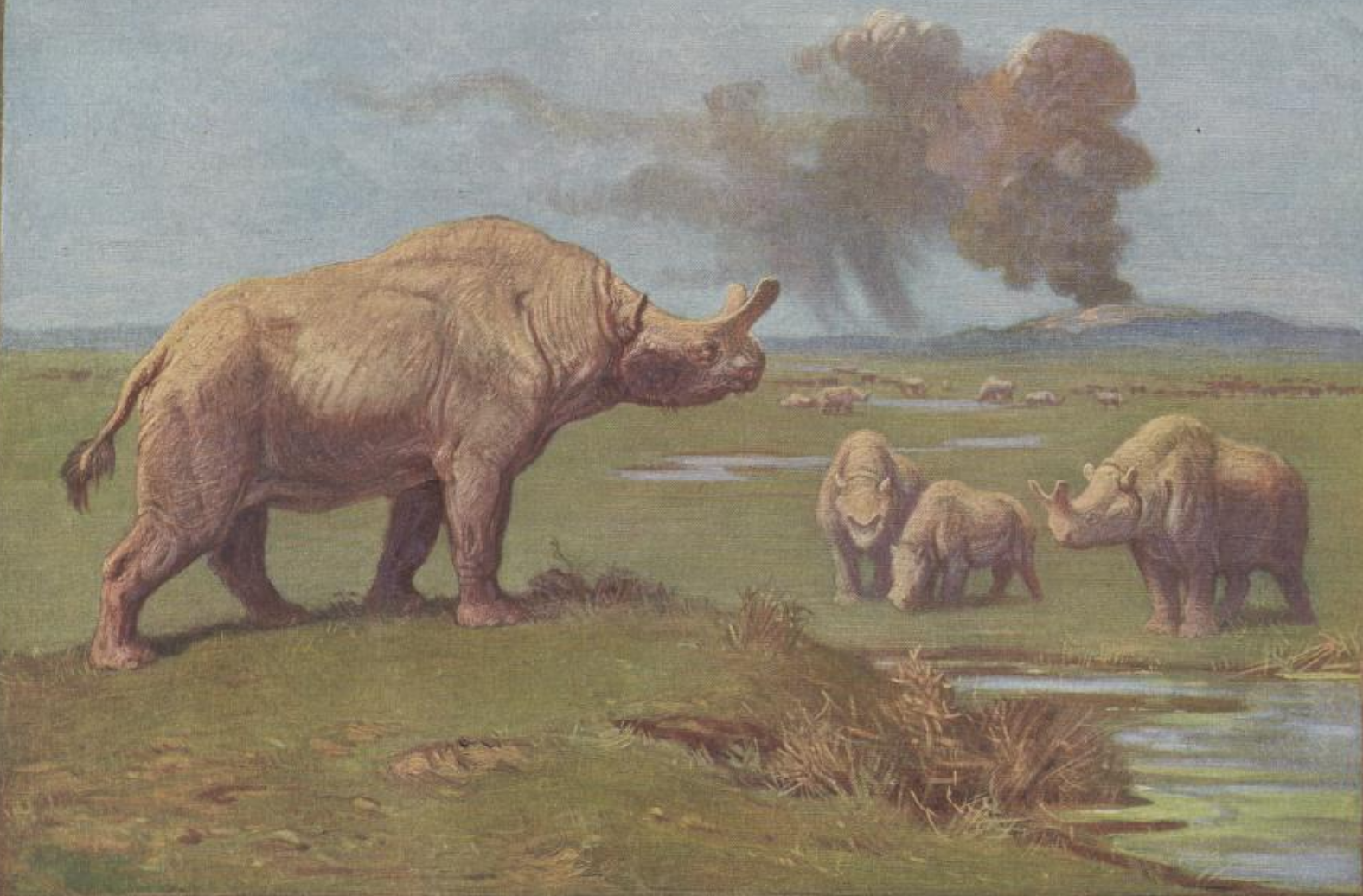
Image Source: United States Library of Congress
Oligocene (33.9 million to 23 million years ago)
During the Oligocene, sea levels lowered considerably as permafrost formed at the Earth’s North and South Poles. With more exposed land, there was room for early horse and rhinoceros relatives, oreodonts, and other mammals to roam.
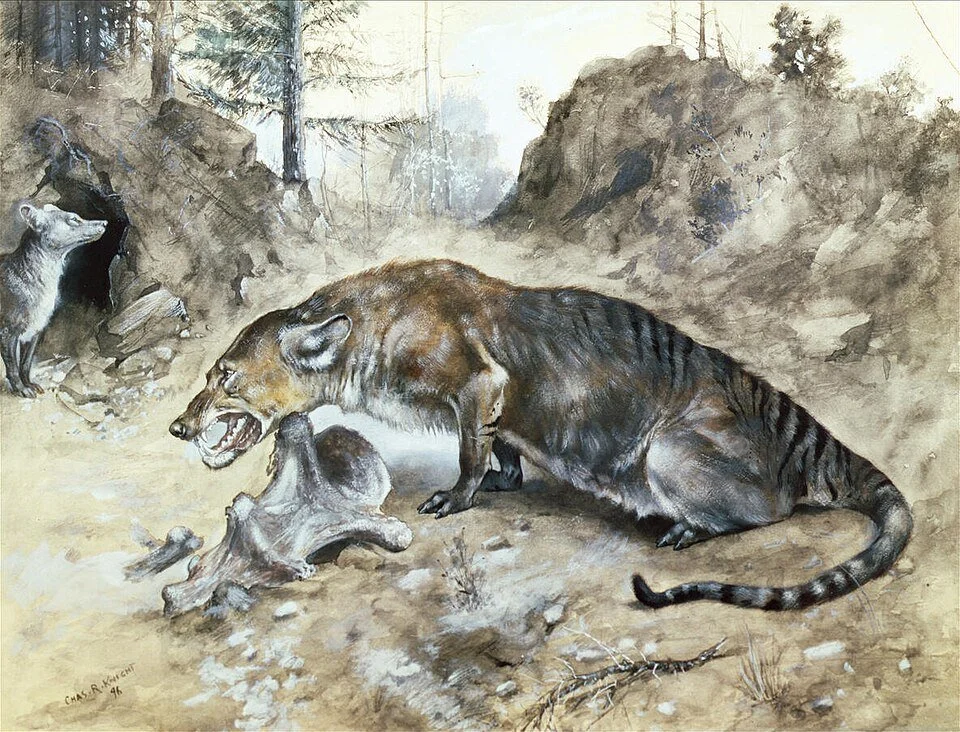
“Mesonyx” by Charles R. Knight.
Eocene (56 million to 33.9 million years ago)
The Eocene epoch began hot and humid with high sea levels and tropical forests near each of the poles. This time period saw rapid mammalian development with the relatively recent absence of dinosaurs.
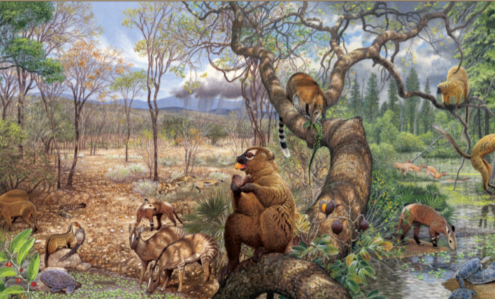
Image (cropped) by Masato Hattori. Published by USGS
Paleocene (66 million to 56 million years ago)
Following the K-Pg Extinction Event that put an end to the age of the non-avian dinosaurs, the Paleocene was a stretch of time in which newly freed up biological niches were up for grabs. Mammals, which had been small and diminutive under the reign of dinosaurs began to grow larger and more diverse. During this time hoofed animals, canine-like carnivores, and early primates established themselves in the fossil record. Large reptiles and crocodilians also rose up as apex predators on land, while sharks took over the oceans in the absence of large marine reptiles like mosasaurs and plesiosaurs.
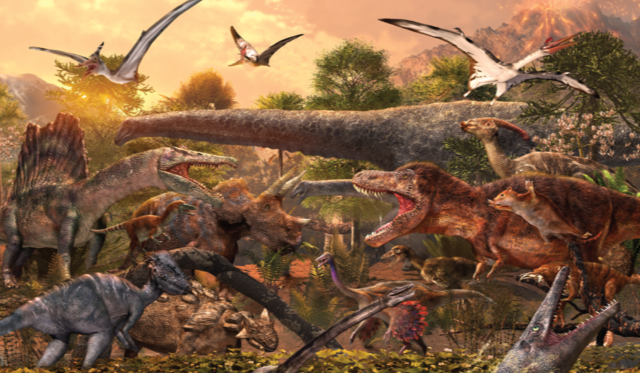
Image (cropped) by Masato Hattori. Published by USGS
Cretaceous (145 million to 66 million years ago)
The Cretaceous was the third and last period of the age of the dinosaurs. The world was warm and tropical with new flowering plants dotting the lush landscape. The skies were dominated by large pterosaurs like the Quetzalcoatlus , the seas by large marine reptiles like the Mosasaurus, and the lands by carnivorous dinosaurs like the Tyrannosaurus rex. The Cretaceous period was ended by the K-Pg Extinction Event and a number of subsequent environmental disasters, killing all large animals on land and many more marine species.
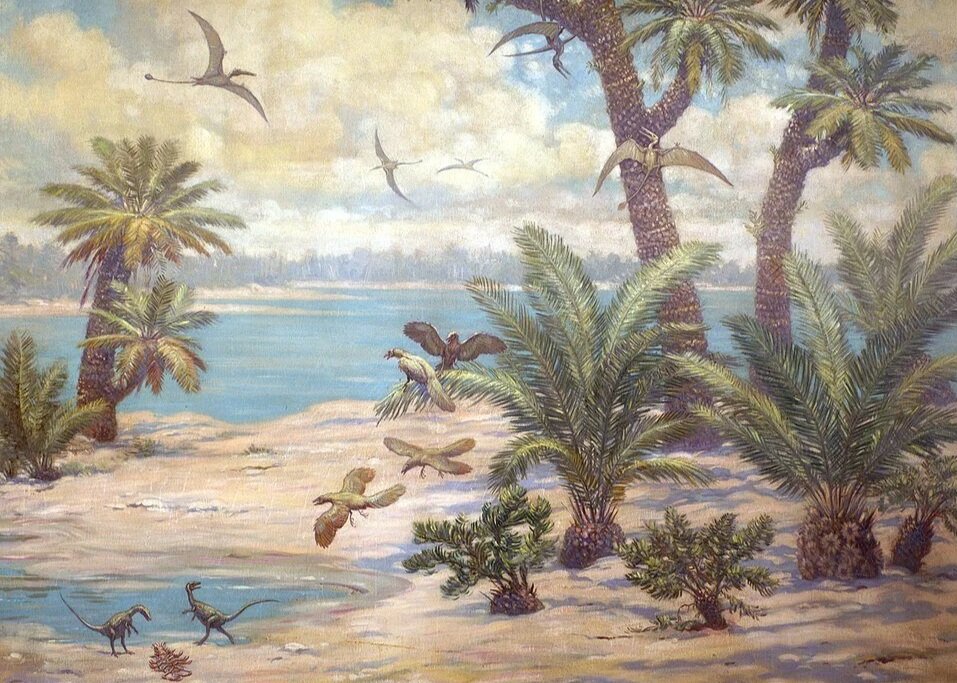
Cropped imaged of “Archaeopteryx, Compsognathus and Rhamphorhynchus” by Charles R. Knight
Jurassic ( 201.3 million to 145 million years ago)
The Jurassic period was the middle age of the dinosaurs. During this period, the supercontinent of Pangea broke apart and the smaller continents we know today began drifting away from eachother. Large sauropods lake the Brachiosaurus lumbered across the lands as well as armored dinosaurs like the Stegosaurus and vicious carnivores like the Allosaurus. Early birds also made their first appearance during the Jurassic in the form of Archaeopteryrx.
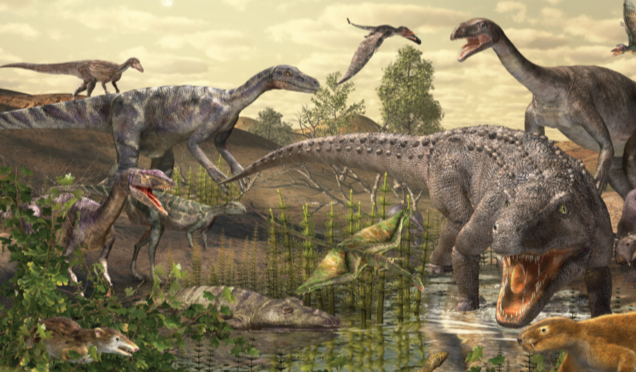
Image (cropped) by Masato Hattori. Published by USGS
Triassic (251.9 million to 201.3 million years ago)
Following the devastation of the Permian-Triassic Extinction Event (The Great Dying), life on land and sea slowly recovered and new species diversified in its wake. The Triassic period is known for the first appearance of dinosaurs like the Coelophysis, pterosaurs, true mammals, and the dominance of reptiles like the marine Ichthyosaurus. The Triassic ended with the Triassic-Jurassic Extinction Event.
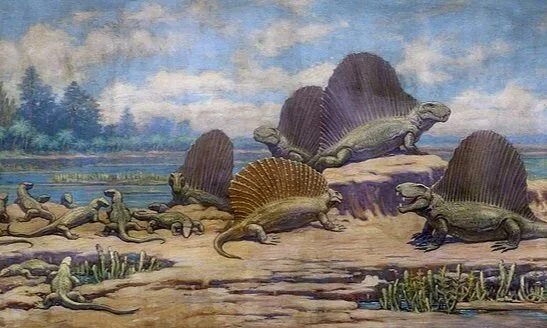
Cropped imaged of “Permian Reptiles and Amphibians” by Charles R. Knight.
Permian (298.9 million to 251.9 million years ago)
The Permian was a time of transition. The planet’s climate warmed up and dried out, ancestors of mammals and reptiles developed, all major land masses shifted together to form one supercontinent called Pangea. The new groups of land animals included two major clades: synapids (ancestor to mammals) and sauropsids (ancestors to reptiles, birds, and crocodilians). The Permian ended with a mass extinction event commonly called "The Great Dying".

USGS; Diarama by Masato Hattori. Map courtesy of Colorado Plateau Geosystems Inc., Public domain, via Wikimedia Commons (cropped)
Pennsylvanian (323.2 million to 298.9 million years ago)
The Pennsylvanian is the name given to the latter half of the Carboniferous period. Unlike the previous Mississippian period, the Pennsylvanian saw volatile changes in weather and sea level and was considerably colder than the first half of the Carboniferous. Collisions of land masses brought new mountain ranges like the Appalachians. The lands were lush with dense vegetation which helped fill the atmosphere with high levels of oxygen, which allowed insects and arthropods to grew to tremendous sizes. The dense forests of ferns, horsetails, and lycopsids (scale-bark trees) were repeatedly flattened by rising and falling seas, eventually becoming coal. These coal beds make up much of the coal we use today.

James St. John, CC BY 2.0 <https://creativecommons.org/licenses/by/2.0>, via Wikimedia Commons
Mississippian (358.9 million to 323.2 million years ago)
The Mississippian comprised the first half of the Carboniferous period. During the Mississippian, the world was warm and the sea levels were so high that shallow seas swallowed up a significant portion of the land, especially in North America. Marine species flourished in this period, especially sharks, which became the dominant predator of the oceans after the extinction of the placoderms.
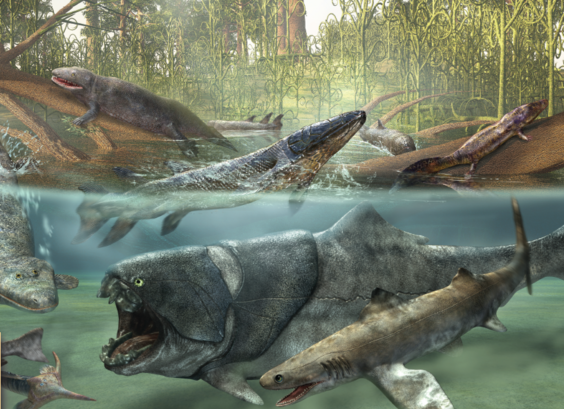
Image (cropped) by Masato Hattori. Published by USGS
Devonian (419.2 million to 358.9 million years ago)
It is in the Devonian period that life finally establishes itself on land. Plants grew and created the first true forests where insects and other arthropods begin flourish. The ancestor to all land vertebrates, Tiktaalik, crawled onto land while placoderms (armored fish) like the Dunkleosteus dominated the oceans. The Late Devonian Extinction marked the end of the Devonian Period.

Віщун, CC BY 3.0 <https://creativecommons.org/licenses/by/3.0>, via Wikimedia Commons
Silurian (443.8 million to 419.2 million years ago)
Life was largely confined to the sea during the Silurian. The first jawed fish developed in the oceans alongside eurypterids (commonly known as “sea scorpions”) and the sea floors began filling with large coral reefs. The first arthropods and early insects made their way onto land while the first simple land plants began to pepper the desolate landscape.
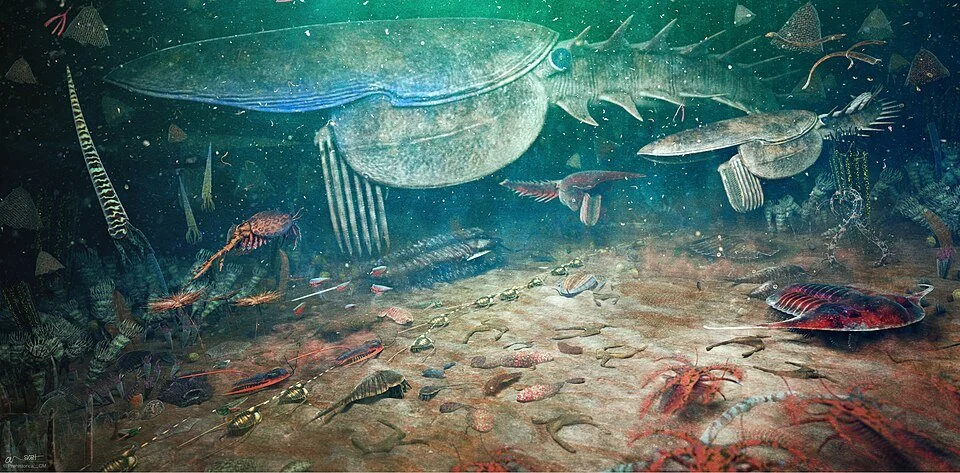
PaleoEquii, CC BY 4.0 <https://creativecommons.org/licenses/by/4.0>, via Wikimedia Commons
Ordovician (485.4 million to 443.8 million years ago)
Following the diversification of life in the Cambrian Period, the Ordovician saw even more new invertebrate species and the first ancestors to all future vertebrates, conodonts. A giant supercontinent called Gondwana converged at the South Pole and was largely submerged under warm shallow seas. The parcel of land that would one day make up Middle Tennessee was submerged during this time, and thanks to erosion, we can find many Ordovician fossils in creeks, by lakesides, and even in our own back yards. Common animals found include crinoids, brachiopods, and nautiloids. The Ordovician period ended with the Late Ordovician Extinction Event.

Zhixin Sun, Fangchen Zhao, Han Zeng, Cui Luo, Heyo Van Iten, Maoyan Zhu, CC BY 4.0 <https://creativecommons.org/licenses/by/4.0>, via Wikimedia Commons
Cambrian (538.8 million 485.4 million years ago)
The Cambrian Period marks the beginning of complex life on Earth. In the warm shallow seas, a burst of diversification of life called the Cambrian Explosion resulted in millions of new species inhabiting the ancient oceans. Life during this period by modern standards often looked bizarre with animals like the Anomalocaris and Hallucigenia. Other more familiar species that developed during this time were trilobites, bivalves, brachiopods, and early starfish.
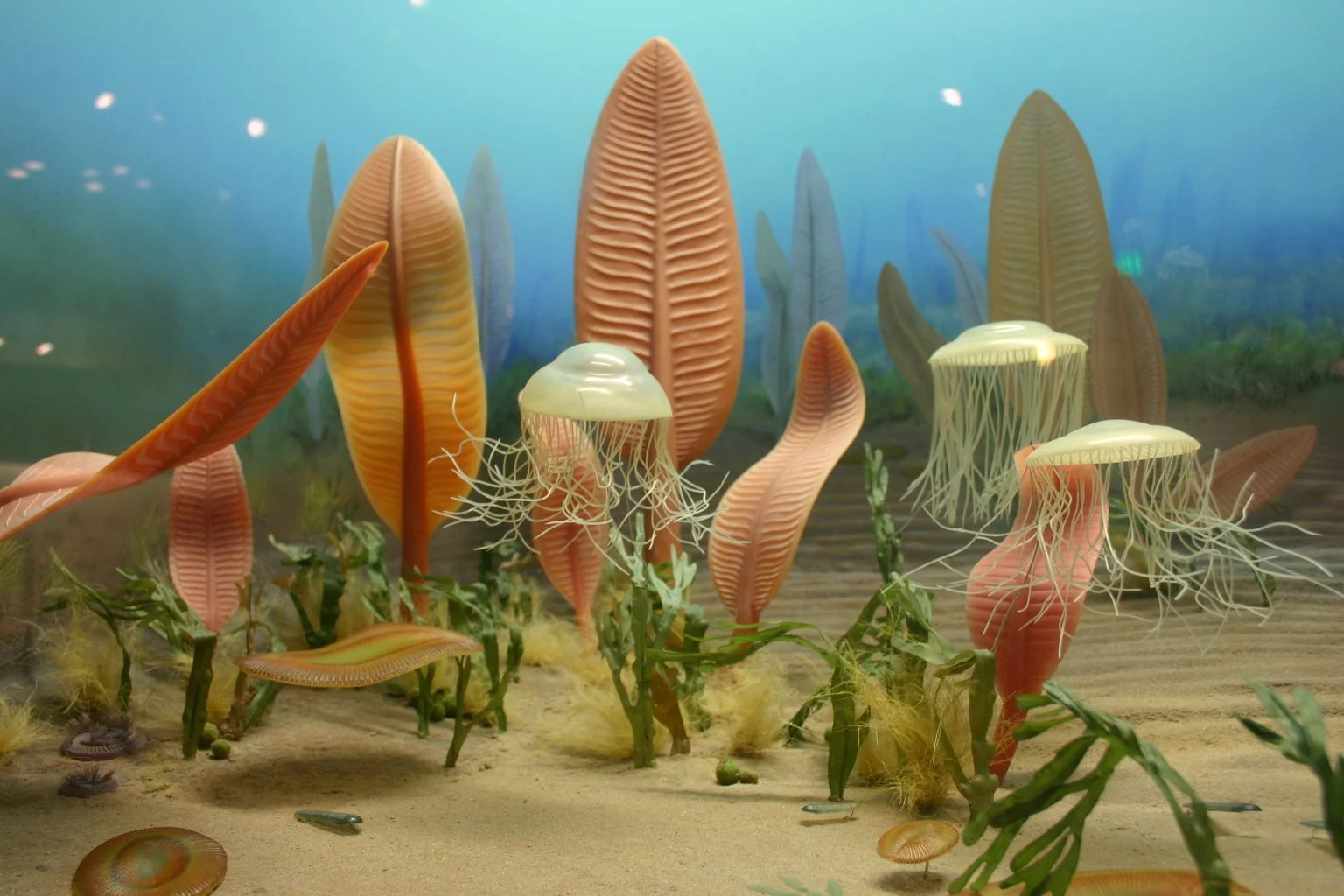
Ryan Somma, CC BY-SA 2.0 <https://creativecommons.org/licenses/by-sa/2.0>, via Wikimedia Commons
PreCambrian (Proterozoic: 2.5 billion to 538.8 million years ago) (Archean: 4.031 billion to 2.5 billion years ago)
The Proterozoic and Archean eons are both considered part of the PreCambrian. The first evidence of single-celled life has been found as far back as the Archean. Sometimes, mats of these single-celled bacteria would multiply and form layers of mats called stromatolites. Later into the Proterozoic, simple multicellular began to populate the ancient seas. Animals like Dickinsonia and Tribrachidium slowly roved the ocean floors without fear of predators, which would not appear as part of the ecosystem until the Cambrian period.