
Mass Extinction Events
Throughout the history of life on Earth, there have been five major catastrophic environmental upheavals that resulted in the extinction of a large percentage of the species living at the time.
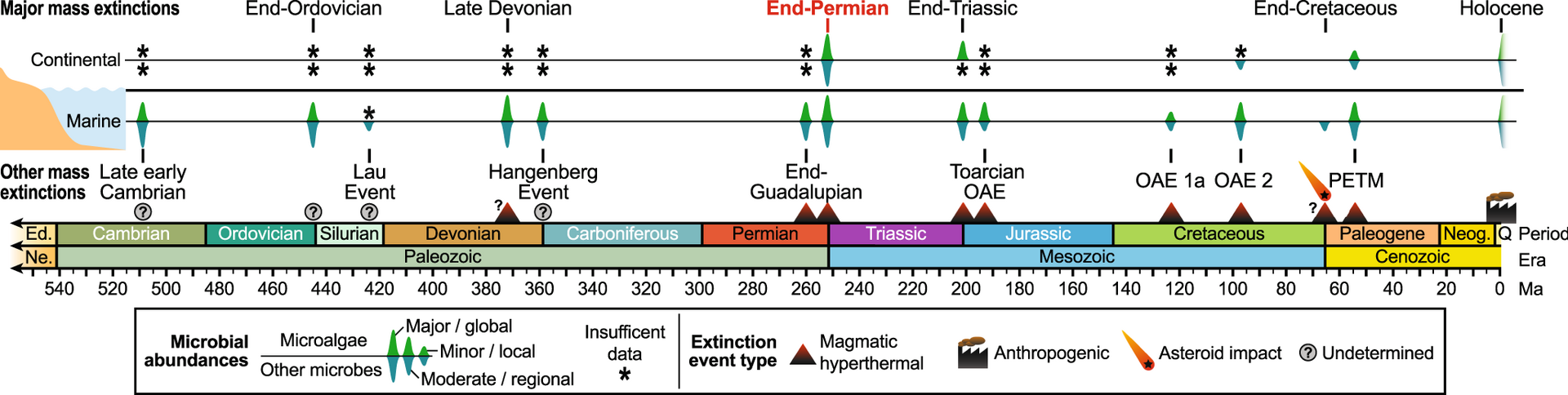
Authors of the study: Chris Mays, Stephen McLoughlin, Tracy D. Frank, Christopher R. Fielding, Sam M. Slater & Vivi Vajda, CC BY 4.0 <https://creativecommons.org/licenses/by/4.0>, via Wikimedia Commons
Late Ordovician Extinction
The first major extinction event(s) occurred as a result of two major swings in global temperature. Due to an excess of cyanobacteria overproducing oxygen, the temperature plummeted on Earth, lowering sea levels and introduced toxicity into the shallow waters. A few million years later, the climate swung the other direction, hitting the recovering populations with a very hot double-whammy. Overheated water resulted in poor oxygenation, and another round of extinctions occurred. All said, the Late Ordovician Extinction resulted in the extinction of 85% of all living species and 49-60% of all genera.
Late Devonian Extinction
The Late Devonian was riddled with multiple waves of extinctions which likely stemmed from more climate change and lower oxygen levels in the oceans. However, while this extinction event devastated fish and other marine life, animals and plants that had made their home on dry land faired pretty well. The Late Devonian Extinction saw to the end 50 - 60% of all marine genera, including all the placoderms and many trilobite species.
Permian-Triassic Extinction, or "The Great Dying"
Of the five major extinction events, the Permian-Triassic was the most devastating on both land and sea. The problems seen in earlier mass extinctions like climate shifts and lack of oxygen in the oceans caused the expected death toll, but the planet was also hit with major volcanic upset which caused carbon dioxide to fill the atmosphere. The land animals suffered extreme greenhouse gasses and low oxygen levels while the oceans warmed up and suffocated much of the marine life. Overall, this catastrophe led to the extinction of 90% of marine species and 70% of terrestrial species. Amongst them were the rest of the trilobites, eurypterids, gorgonopsids, and the reptilian protomammals knowns as dinocephalians.
Triassic-Jurassic Extinction
The Triassic-Jurassic Extinction’s cause is not completely clear. The general theory for what caused this extinction was volcanic activity generated from the supercontinent Pangea breaking apart. As with the Great Dying, excess carbon dioxide caused high temperatures and low oxygen levels, resulting in an estimated 80% of marine species going extinct. The silver lining is that the Triassic-Jurassic Extinction ushered in the way for dinosaurs to expand, diversify, and ultimately dominate the land for the next 165 million years.
Cretaceous-Paleogene (The K-pg Extinction)
The most famous of all extinction events came at the end of the Cretaceous period. This extinction has many names including the Cretaceous-Paleogene Extinction, the K-T Extinction, the K-pg Extinction, and perhaps most commonly “the asteroid that took out all the dinosaurs”. Whatever you call it, this extinction event was devastating and relatively quick. In the Yucatan Peninsula in modern day Mexico, an asteroid several miles wide slammed into the Earth. The impact itself killed everything within a 600–1000-mile radius, but it was the aftermath that truly decimated every last one of the non-avian dinosaurs and all the pterosaurs. In addition to a potential increase in seismic activity (which as we have seen spells bad news for the climate), the dust thrown into the atmosphere blocked out the sun for almost two whole years, resulting in a complete halt to photosynthesis. No photosynthesis means no more plants. No more plants means no more plant-eating dinosaurs (who required large amounts of plant matter daily to survive). No more plant-eating dinosaurs means no meat-eating dinosaurs. In truth, no sunshine meant no terrestrial animals over the size of about a house cat could survive with so little food. Small animals ate seeds, insects, and other small morsels to survive, but their larger counterparts died out within twenty years of the asteroid’s impact. However, it is incorrect to say all the dinosaurs died in the K-pg Extinction. The smallest, most resourceful winged-theropods managed to eke out an existence in those bleak, dark years, and now grace our skies as modern birds.
How do we know that’s what happened?
Geologists and Paleontologists were able to piece together this story by 1.) finding the impact site itself, and 2.) Finding the world-wide layer of dust left behind. The K-T or K-pg Boundary is a thin rock layer that contains high amounts of iridium, an element that is incredibly rare anywhere else in the Earth’s crust. Iridium is, however, abundant in asteroids. Better yet, there are no non-avian dinosaur fossils found above the K-pg Boundary, telling Paleontologists that the impact was the final death knell of the age of the dinosaurs.